

Planning a destination wedding in Italy involves more than choosing a beautiful venue and setting a date. This guide explains the legal requirements to get married in Italy for foreign couples, so you can understand documents, timelines, and procedures before you start.
Table of Contents
Understanding Legal Requirements to Get Married in Italy
Getting legally married in Italy as foreign citizens means complying with both Italian law and the laws of your home countries. Before you look at venues and styling, it is essential to understand how Italy defines a valid marriage, which authorities are involved, and which conditions you must meet to be considered legally free to marry.
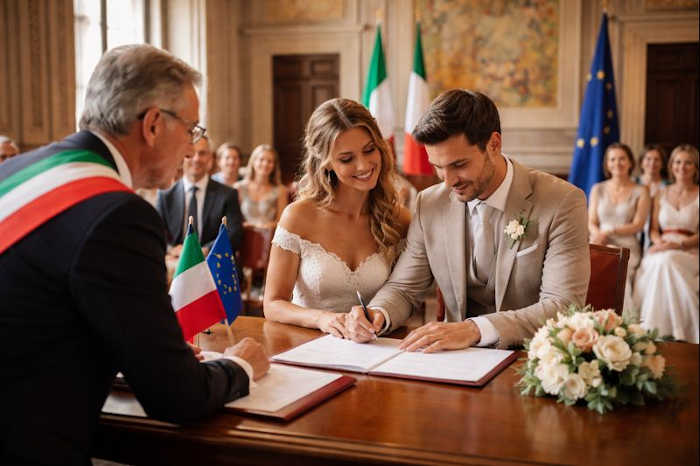
Key point: A wedding in Italy is legally valid only if it respects Italian civil law and</em the legal requirements of each partner’s country of citizenship.
Legal capacity to marry
Italian authorities will first look at your legal capacity to marry. In practice, this means you must:
- Be of legal age to marry under Italian law and under the law of your home country (in Italy this is generally 18, with limited exceptions that require specific court authorization).
- Not be currently married to someone else (no existing marriage that has not been legally dissolved).
- Not be closely related by blood, marriage, or adoption in ways that are prohibited by Italian Civil Code.
- Be able to give free and informed consent at the time of the ceremony.
In simple terms: you must be of age, single (or legally divorced/widowed), not closely related, and able to give clear consent in front of the Italian registrar.
Nulla Osta and certificates of no impediment
For foreign nationals, the central legal requirement is proof that you are free to marry under your own national law. Under Article 116 of the Italian Civil Code, this is normally provided through one of the following:
- A Nulla Osta (certificate of no impediment), issued by the competent authority in your country of citizenship or by its embassy/consulate in Italy, confirming that there are no legal obstacles to the marriage under your national law.
- A certificate of legal capacity to marry for citizens of countries that have ratified the Munich Convention of 5 September 1980 (for example, Germany, Austria, Spain, the Netherlands, Switzerland, Portugal and others). This certificate usually replaces the Nulla Osta and, for these countries, is generally exempt from further legalization and translation requirements.
This document is what allows the Italian town hall (comune) to accept your application and schedule your civil or religious-with-civil-effects ceremony. Without it, the registrar cannot proceed.
Important: the issuing authority, format, validity period, and legalization requirements for the Nulla Osta or certificate of capacity vary by nationality. Always verify the current rules with your consulate or embassy in Italy and with the town hall where you plan to marry.
Italian town hall requirements for foreign couples
Once you have the necessary documents from your home country, you must comply with the internal procedures of the Italian municipality where the marriage will take place. In general terms, foreign couples can marry in Italy even if they are not resident, but the process differs depending on residency status:
- Foreign residents in Italy usually follow the standard Italian procedure, which often includes the posting of marriage banns (pubblicazioni di matrimonio) at the municipality of residence for a fixed period before the ceremony.
- Foreign citizens who are not resident in Italy are typically not required to post banns. Instead, they sign a formal declaration before the registrar confirming that no legal impediments exist (for example, no previous undissolved marriage and no prohibited family relationship). This is normally done at the town hall where the marriage will be celebrated, shortly before the ceremony.
Specific timing, appointment availability, and local documentation practices can vary between municipalities, especially in popular wedding destinations. It is therefore essential to ask the town hall for a written list of requirements and deadlines as early as possible.
Language, translations, and interpreters
Another key legal aspect is language. The registrar and the official marriage records in Italy operate in Italian. This has three main consequences:
- Documents issued abroad and not in Italian usually need an official translation into Italian. Depending on your country and the type of document, an Apostille or consular legalization may also be required before the Italian authorities will accept them.
- If you or your partner do not speak Italian, an interpreter is normally required both for the pre-wedding declarations and for the ceremony itself, so that you fully understand what you are declaring and signing.
- The interpreter is expected to swear before the registrar that they will translate faithfully. In many municipalities, you must provide the interpreter yourself; the town hall does not arrange this service.
Remember: Italian law requires that you understand the content of your declarations and the ceremony. If you do not speak Italian, arranging a qualified interpreter is not just helpful; it is a legal safeguard for the validity of your marriage.
Different combinations of nationalities and situations
The exact combination of documents and steps can change depending on your situation. For example:
- Two foreign citizens with the same nationality.
- Two foreign citizens with different nationalities.
- Mixed couples where one partner is Italian and the other is foreign.
- Couples including a divorced or widowed partner, or partners who have changed their name or citizenship.
In some cases, additional court authorizations or supporting documents are required (for example, for a woman whose previous marriage ended less than a certain number of days before the new marriage date, or where a home country has complex restrictions on remarriage). These are highly specific scenarios and must always be evaluated with the competent consulate and, if needed, a legal professional.
Key takeaway: the core structure of the law is the same for everyone — prove you are free to marry under your own national law, comply with Italian civil rules, and follow the local procedure at the chosen town hall. The details change with your nationality, residency, and personal history.
Types of Marriage Ceremonies in Italy
When you decide to get married in Italy, it is crucial to distinguish between ceremonies that produce legal effects and ceremonies that are purely symbolic. The format you choose will determine which documents you need, which authorities are involved, and where your marriage will be officially registered.

Key distinction: in Italy, only a civil ceremony or a religious ceremony with civil effect creates a legally valid marriage. A symbolic or blessing ceremony alone has no legal value.
Civil marriage at the town hall or authorized venue
The most straightforward option for foreign couples is a civil ceremony. Civil weddings in Italy are usually celebrated by the mayor or an appointed officer at the local town hall (comune) or at another venue officially authorized as a “casa comunale” (for example, a historic villa, palace, or castle that the municipality has designated for civil ceremonies).
During a civil ceremony:
- The registrar reads the articles of the Italian Civil Code relating to marriage.
- You declare that you wish to marry in the presence of the registrar and the required witnesses.
- The marriage is recorded in the civil register of the municipality, and you can obtain an official Italian marriage certificate.
Civil ceremonies are open to foreign couples who meet the legal requirements and have submitted the correct documentation (including the Nulla Osta or equivalent certificate of no impediment when required). You do not need to be resident in Italy, but you must follow the specific procedure and timings of the chosen municipality.
Summary: a civil wedding at the town hall or authorized venue is the most direct way to obtain an Italian marriage certificate that is valid under Italian law and, once recognized, in your home country.
Catholic and other religious ceremonies with civil effect
Italy also allows certain religious weddings to have civil effects, meaning the ceremony is both religious and legally valid at the same time. The most common example for foreign couples is the Catholic wedding with civil effect.
In a Catholic wedding with civil effect:
- The couple completes both religious preparation and the civil paperwork required by the Italian authorities.
- The priest celebrates the religious ceremony and collects the signatures of the couple, witnesses, and officiant on the civil registers.
- The parish transmits the documentation to the town hall, which then records the marriage in the civil register.
Once this process is completed correctly, the marriage is valid both as a sacramental marriage under Canon Law and as a civil marriage under Italian law, and an Italian marriage certificate can be issued.
Beyond Catholic weddings, some other religious communities that have a formal agreement with the Italian State may also celebrate ceremonies with civil effect. In these cases, the minister of religion acts in a similar way to the priest in a Catholic wedding and the marriage is registered by the civil authorities after the ceremony.
Important: not every religious ceremony in Italy automatically has civil effect. The minister must be authorized and the required civil paperwork must be completed and properly registered for the marriage to be legally valid.
Religious-only and symbolic ceremonies (no legal effect)
Many destination weddings in Italy include a ceremony that is religious-only or symbolic. These are very popular for couples who want a personalized or scenic celebration but handle the legal part separately.
Examples include:
- A symbolic ceremony in a garden, villa, vineyard, or beach club, led by a wedding celebrant in Italy or friend.
- A religious blessing when the couple has already married civilly in their home country.
- A personalized ceremony that includes vows, readings, and rituals but no registrar or legally authorized officiant.
These ceremonies can be meaningful and beautiful, but they do not create a legal marriage under Italian law. If you choose this route, you will need a civil ceremony either in Italy (at a town hall or authorized venue) or in your home country before or after the symbolic event, depending on what your national law requires.
Summary: a symbolic or blessing ceremony is ideal if your priority is the experience and setting, but the legal marriage must take place separately, and only the civil ceremony will generate official marriage certificates.
Combining legal and symbolic elements
Many foreign couples decide to combine formats to balance legal clarity and a customized celebration. Common approaches include:
- Having a simple civil ceremony at the Italian town hall on one day, followed by a symbolic ceremony at Italy wedding venues on another day.
- Celebrating a Catholic wedding with civil effect in a church, then hosting a symbolic renewal of vows or additional ritual at the reception location.
- Completing the legal marriage in the home country for practical reasons, then organizing a symbolic ceremony in Italy that mirrors the style of a full wedding.
Whichever combination you choose, it is essential to coordinate with the town hall, your religious officiant (if any), and your planner or venue so that everyone understands which event is legally binding and which is purely ceremonial.
Key takeaway: in planning your Italian wedding, decide early if you want the legal marriage to take place in Italy or elsewhere. This choice determines whether you need a civil or religious-with-civil-effect ceremony in Italy, or whether a symbolic ceremony is enough because the legal part will be handled in your home country.
Essential Documents for Foreign Couples
Once you understand the general legal framework, the next step is to collect the correct documents. Exact requirements depend on your nationality, personal situation, and the municipality where you will marry, but most foreign couples will work with a similar core set of documents.

Key point: you must usually provide proof of identity, proof that you are free to marry under your own national law, and certified translations/legalization where required. Always confirm details with both your consulate/embassy and the Italian town hall.
Passports and basic identity documents
Each partner must provide valid identification. In most cases this means:
- A valid passport (or national identity card for citizens of EU/EEA countries where an ID card is sufficient for travel within the EU).
- Additional proof of residence if requested by your consulate or by the town hall (for example, a residency certificate or recent utility bill in your home country).
The names, dates of birth, and other details on all your documents must be consistent. Any discrepancy (for example, different spellings of a name) may require additional supporting documents or declarations.
Certificate of no impediment / Nulla Osta
For foreign citizens, the central document is proof that you are legally free to marry according to the law of your home country. Depending on your nationality, this may take one of the following forms:
- Nulla Osta issued by your embassy/consulate in Italy or by another competent authority. This document states that, under the law of your country, there are no legal obstacles to the marriage.
- Certificate of legal capacity to marry for citizens of countries that apply the Munich Convention of 5 September 1980. For these nationals, the certificate normally replaces the Nulla Osta and is often accepted without further legalization.
The Nulla Osta or equivalent document normally includes personal data (name, date and place of birth), marital status (single, divorced, widowed), and confirmation that you may legally marry the named partner under your national law. It must be issued in the manner required by your country (sometimes in your home country, sometimes directly by the consulate in Italy) and may have a limited validity period.
Important: the way you obtain this certificate, how long it remains valid, and whether it needs an Apostille or consular legalization varies by nationality. Your first step should always be to consult your consulate or embassy for up-to-date instructions.
Birth certificates
Many Italian municipalities ask foreign couples to provide a full-length birth certificate (showing parents’ names), especially when required by the consulate that issues the Nulla Osta or certificate of capacity to marry. In some cases this certificate must:
- Be issued within a recent period (for example, within the last 3 or 6 months, depending on local practice).
- Be legalized or bear an Apostille, according to whether your country is part of the Hague Apostille Convention.
- Be translated into Italian by a sworn translator, or be accompanied by an official multilingual extract if your country issues them.
The town hall and your consulate will tell you if a birth certificate is required in your specific case and in which format.
Proof of termination of previous marriages
If one or both partners have been previously married, Italian authorities need proof that the previous marriage has been legally terminated. This normally involves:
- A divorce decree that is final and legally effective, or
- A death certificate for a deceased spouse, or
- Other official documentation that proves the previous marriage has ended according to your national law.
These documents may have to be legalized (Apostille or consular legalization) and translated into Italian. In some cases, your home country’s authorities will also reflect the divorce or widow(er) status in the Nulla Osta or certificate of capacity to marry, which Italian authorities rely on as confirmation.
Summary: if you have been married before, you must show that the previous marriage has ended definitively under your own legal system. The Italian registrar cannot proceed without clear proof.
Certificates or declarations of marital status
Depending on your nationality, you may be asked to provide an official certificate of marital status (for example, “certificate of single status” or “certificate of family status”) issued by the competent authority in your home country. In other cases, your consulate will incorporate this information into the Nulla Osta.
For some countries, the Italian authorities may accept a sworn declaration made by you before the consular authority or before an Italian registrar, confirming your marital status and that there are no impediments to your marriage under your national law. Whether this is possible depends entirely on the rules of your home country and the instructions of the local authorities.
Translations, Apostilles, and legalization
Most documents issued outside Italy must comply with Italian rules on legalization and translation. In general:
- If your country belongs to the Hague Apostille Convention, documents may require an Apostille from the designated authority in your country.
- If your country is not part of the Convention, documents may need consular legalization at the Italian consulate or according to the agreements in force between Italy and your state.
- Documents not issued in Italian usually need an official translation into Italian, done by a sworn translator, by the consulate, or in the way specified by the town hall.
In some situations (for example, certificates issued on multilingual EU forms or certificates of legal capacity to marry under the Munich Convention) legalization and translation requirements may be simplified. The town hall and your consulate can confirm when this applies.
Practical tip: create a list of every document you plan to submit and note for each one whether it needs an Apostille, legalization, and/or translation. This makes it easier to track what has been completed and what is still pending.
Witnesses’ details
Italian law requires the presence of witnesses at the marriage ceremony (commonly two witnesses, one for each partner). Some municipalities ask for:
- Full names, dates and places of birth, and addresses of each witness.
- Copies of their passports or identification documents.
Witnesses do not necessarily need to be Italian citizens; however, they must be legally able to act as witnesses and typically be adults. If your witnesses do not speak Italian and the ceremony is conducted in Italian, an interpreter will usually assist so that everyone understands the essential parts of the ceremony and the documents being signed.
Additional documents in specific situations
Depending on your personal circumstances, Italian authorities or your consulate may request extra documents, such as:
- Certificates or authorizations in case of name changes, adoption, or complex family situations.
- Specific authorizations for partners who are under a certain age, where allowed, or subject to particular legal restrictions in their country.
- Documentation related to citizenship changes or dual citizenship.
Key takeaway: there is a common core of documents for most foreign couples, but details vary by nationality and personal history. Always work with two checklists: one from your consulate or embassy and one from the Italian town hall where the wedding will be registered.
Timeline and Step-by-Step Process
Because consular rules, translations, and town hall procedures take time, it is important to treat the legal side of your Italian wedding as a project with clear stages. The outline below shows how most foreign couples structure the process, and which actions are usually taken at each phase.

Key idea: work in two parallel tracks — one with your consulate or embassy and one with the Italian town hall. Every step should be checked against the written instructions of both.
6–12 months before the wedding: research and initial planning
As soon as you decide to marry in Italy, you should:
- Choose a region and identify one or more preferred municipalities (comuni) and venues.
- Decide if the ceremony in Italy will be civil, religious with civil effect, or symbolic only (with the legal marriage handled in your home country).
- Visit the official website of your consulate or embassy in Italy and download their latest guidelines for marriages in Italy.
- Contact the wedding office of the chosen town hall to request their current checklist for foreign citizens and to ask about available dates, fees, and practical arrangements.
At this stage, you are not usually submitting documents yet. The goal is to understand which certificates you will need, how recent they must be, and how long it takes to obtain them.
Practical tip: create a shared digital folder for all documents and correspondence (consulate instructions, town hall emails, scans of certificates). This makes it much easier to keep track of deadlines and requirements.
3–6 months before the wedding: securing dates and collecting documents
Once you have clear written instructions from both the consulate and the municipality, you can begin the concrete steps:
- Confirm and reserve the ceremony date and time with the town hall or authorized venue, according to their booking rules and fees.
- Request updated birth certificates, marital status certificates, or other civil status documents from your home country, if required.
- Check passport validity and renew if necessary.
- Clarify with your consulate how and when you must apply for the Nulla Osta or certificate of legal capacity to marry (and which supporting documents they need).
- If you are planning a religious ceremony with civil effect (for example, Catholic), start the church preparation and ask the parish which documents are required on the religious side and how they coordinate with the civil authorities.
During this phase you should also check the timing rules for each document. Some certificates are considered valid only for a limited number of months, so your town hall and consulate may advise you not to obtain them too early.
1–3 months before the wedding: Nulla Osta, Apostilles, and translations
This is usually the most technical part of the process, where the focus is on producing final, legally acceptable documents:
- Apply for the Nulla Osta or certificate of legal capacity to marry following your consulate’s procedure (which may involve appointments, sworn declarations, or submission of original documents).
- Obtain any required Apostilles or consular legalization on your birth certificates, divorce decrees, or other civil status documents, if requested.
- Arrange official translations into Italian for documents that are not already in Italian or in a format accepted without translation.
- Book a qualified interpreter if you or your partner do not speak Italian and the town hall requires an interpreter for the declarations and ceremony.
- Collect and confirm details of your witnesses, including copies of their IDs if requested by the municipality.
Most town halls ask you to send scanned copies of all documents in advance for a preliminary check. This does not replace the need to present originals, but it helps to identify any issues before you travel.
Important: do not assume that a document that looks “official” will be accepted automatically. Always ask the town hall to confirm in writing that the format, legalization, and translation of each document are acceptable.
2–4 weeks before the wedding: confirmation with the town hall
Once your documents are issued, legalized, and translated, there is a final round of coordination:
- Send complete scans of your documents to the town hall, if you have not done so already, and ask them to confirm that everything is in order.
- Check the exact appointment date and time for any pre-wedding declaration at the municipality (for non-resident foreign couples this is often scheduled shortly before the ceremony).
- Confirm logistics with your interpreter and witnesses, ensuring they know where and when they must be present and what identification they should bring.
- If your consulate requires any final steps (for example, issuing the Nulla Osta close to the date), complete these following their deadlines.
At this stage, you should have a clear written confirmation from the town hall that your paperwork is acceptable and that the ceremony is booked.
A few days before the ceremony: pre-wedding declarations
Foreign couples who are not resident in Italy are usually not required to publish marriage banns, but they must still make formal declarations before the registrar. Local practice varies, but commonly you will:
- Attend an appointment at the town hall (sometimes 1–2 days before the wedding, sometimes on the same day) to present the original documents.
- Sign the declarations required by the Italian Civil Code, confirming that there are no legal impediments to your marriage and that the information in your certificates is correct.
- Have your interpreter present, if needed, so that you fully understand the content of these declarations.
Once these declarations are accepted and the registrar confirms that all requirements are met, the town hall can proceed with the ceremony on the agreed date.
Summary: the pre-wedding appointment is the moment when your documents are formally checked in original form and your intention to marry is recorded. Without this step, the registrar cannot legally celebrate the marriage.
The wedding day: civil or religious-with-civil-effect ceremony
On the day of the wedding, you, your partner, and your witnesses appear at the town hall, authorized venue, or church (for a religious ceremony with civil effect). During the ceremony:
- The registrar or authorized officiant reads the required articles of the Italian Civil Code.
- You publicly declare that you wish to marry and exchange consent.
- You, your partner, the witnesses, and the officiant sign the appropriate registers.
After the ceremony, the town hall records the marriage in the civil register of the municipality. You can request one or more Italian marriage certificates, which you may later need for name changes, recognition of the marriage in your home country, and administrative procedures.
After the wedding: certificates and recognition in your home country
The process does not always end on the wedding day. In many cases you will need to:
- Request official copies of your Italian marriage certificate (often in the form of an extract or full certificate).
- Obtain an Apostille or consular legalization on the Italian marriage certificate if your home country requires it.
- Follow the procedure indicated by your consulate or national authorities to register or recognize the marriage in your home country, where applicable.
Key takeaway: think of your Italian marriage as a process that continues at home. Keep at least one certified copy of your Italian marriage certificate safely stored, and follow your national rules for recognizing or registering the marriage.
Local Authorities, Translations, and Apostilles
A legally valid marriage in Italy for foreign citizens involves more than a ceremony and a set of documents. Several authorities in Italy and in your home country must cooperate, and documents often need to be translated and legalized before the Italian registrar can accept them. Understanding who does what will help you organize the process in a structured way.

Key idea: three main actors are involved in most cases: your home country authorities (and consulate/embassy), the Italian municipality where you marry, and, when required, the Italian authorities responsible for legalization and registration.
The Italian municipality (Comune)
The central authority for your marriage in Italy is the Comune (municipality) where the ceremony will take place. The wedding or civil status office typically:
- Provides the official list of documents required from foreign citizens.
- Checks that your documents respect Italian law and any international conventions applicable.
- Schedules appointments for pre-wedding declarations and for the ceremony itself.
- Celebrates the civil marriage or records the civil effects of a religious wedding.
- Issues and archives the Italian marriage certificate after the ceremony.
Each municipality follows the same national legal framework but may have different internal procedures, forms, and timeframes. For this reason it is essential to obtain written instructions directly from the town hall where your wedding will be registered, not only from general guides.
Embassies, consulates, and home country authorities
Your home country plays a decisive role, because Italian law requires proof that you are free to marry according to the rules of your own national legal system. Depending on your nationality, the following authorities may be involved:
- Your local civil registry office or equivalent authority in your home country, which issues birth certificates, marital status certificates, divorce decrees, and similar documents.
- Your country’s embassy or consulate in Italy, which may issue the Nulla Osta or a similar document stating that there are no impediments to your marriage.
- Authorities in your home country designated to issue Apostilles or carry out legalization of documents destined for use abroad.
These institutions confirm your personal data, marital status, and legal capacity to marry under your national law. Italian authorities rely on this information when deciding whether to authorize the marriage.
Summary: your municipality in Italy manages the procedure and registers the marriage; your home country authorities confirm that you are legally free to marry and issue the documents Italy needs to see.
Translations: who can translate and how
Italian registrars must be able to understand the content of every foreign document they accept. This is why translations are often required. In practice, one of the following solutions is typically used:
- Sworn translations in Italy, carried out by a translator who takes an oath before a competent Italian authority (for example, a court or another office designated by law) that the translation is faithful to the original.
- Translations provided by the consulate of your country, where the consulate expressly declares that the translation corresponds to the original document.
- Multilingual standard forms issued under specific EU or international instruments, in cases where these are accepted by Italy and by the municipality for the type of certificate involved.
The town hall will tell you which type of translation they accept and whether the translation itself must be legalized. Requirements can differ depending on the type of document and on the international agreements in place between Italy and your country.
Important: not every private translation or informal bilingual document will be accepted. The translation must follow the method indicated by the municipality (and, where relevant, by your consulate) to be valid for civil status purposes.
Apostilles and legalization of foreign documents
Italian authorities also need to be sure that a document issued abroad is genuine and has been signed by a competent authority. This is where Apostilles or consular legalization come into play:
- If your country is part of the Hague Convention of 5 October 1961 (Apostille Convention), certain public documents destined for use in Italy may need an Apostille from the authority designated in your country. The Apostille replaces traditional consular legalization between member states.
- If your country is not part of the Convention, your documents may have to go through a different legalization process, which can involve both your national authorities and the Italian consulate in your country.
In both cases, the municipality in Italy and, in many cases, your consulate will indicate exactly which documents require an Apostille or legalization and in which order steps must be completed. The requirement often applies to birth certificates, divorce decrees, and certificates of marital status, but local instructions prevail.
Italian authorities involved in legalization and registration
For certain documents and in specific situations, additional Italian authorities may be involved, such as:
- The Prefecture (Prefettura) or another competent office that deals with legalization of documents within Italy when needed.
- Italian consulates abroad, which may assist with the recognition or registration of your Italian marriage in your home country’s system, depending on your nationality and on internal rules.
From the perspective of your wedding in Italy, the key point is that all foreign documents placed before the Italian registrar must arrive in a form that Italian law recognizes as authentic and intelligible. Legalization and translation rules exist precisely to achieve this.
Coordinating authorities, translations, and timing
Because each authority has its own timings and procedures, good coordination is essential. In practical terms, it helps to:
- Start by obtaining written instructions from your consulate/embassy and from the Comune where you plan to marry.
- List each required document with columns for “issued by”, “translation needed”, “Apostille/legalization needed”, and “validity period”.
- Plan sufficient time for appointments, postal delivery of certificates, legalization procedures, and translations.
Practical tip: never assume that a document that was accepted in another country will automatically be accepted in Italy in the same form. Always verify with the Italian municipality and your consulate before you spend time and money on translations or legalizations.
Key takeaway: your documents must be both authentic (confirmed by Apostille or legalization where required) and understandable in Italian (through sworn or officially recognized translations). Once these conditions are met, the Italian registrar can safely use them to authorize and register your marriage.
Frequently Asked Questions
Can foreign couples get legally married in Italy without being residents?
Yes. Foreign citizens can usually marry in Italy even if they are not resident, provided they meet the legal requirements, obtain a Nulla Osta or equivalent certificate of no impediment when required, and follow the procedure of the municipality where the wedding will be registered. Non-resident couples are generally exempt from publishing marriage banns, but they must still appear before the registrar for the required pre-wedding declarations.
How far in advance should we start the legal paperwork?
[Ipotesi] A practical approach is to start gathering information and planning at least 6–12 months before your intended wedding date. This gives you enough time to obtain certificates from your home country, book appointments with your consulate or embassy, arrange legalization and translations, and coordinate dates with the Italian town hall. Some documents have limited validity, so the exact timing should always follow the written instructions from your consulate and the municipality.
How long do we need to be in Italy before the wedding day?
There is no single nationwide rule that requires a specific number of days in Italy for non-resident foreign couples. However, you must be physically present for at least one appointment at the town hall to sign the required declarations and present the original documents, and you must also be present on the day of the ceremony. [Ipotesi] Many couples choose to arrive several days before the wedding to complete any pending formalities, but the exact timing depends on the municipality’s schedule and your consulate’s requirements, so it is essential to confirm this directly with both.
Is a symbolic ceremony in Italy legally valid?
No. A symbolic or blessing ceremony on its own has no legal effect under Italian law, even if it looks identical to a full wedding from a guest’s perspective. Only a civil ceremony (at a town hall or authorized venue) or a religious ceremony with civil effect creates a marriage that is valid under Italian law. If you choose a symbolic ceremony in Italy, you must arrange the legal marriage separately, either in Italy (with a civil ceremony) or in your home country, according to your national rules.
Will our Italian marriage be recognized in our home country?
In general, a marriage that is validly celebrated in Italy according to Italian law and in compliance with your home country’s requirements for capacity to marry can be recognized abroad. However, many countries require you to register or record the marriage in their own system and may ask for an Apostille or consular legalization on the Italian marriage certificate. [Ipotesi] Your consulate or national civil registry office is the authoritative source for confirming the exact steps needed for recognition at home.
What documents are most critical to avoid problems with the town hall?
The documents that typically cause the most difficulty are those that prove you are free to marry under your national law: the Nulla Osta or certificate of legal capacity to marry, any divorce decrees or death certificates of previous spouses, and birth or marital status certificates that must be legalized and translated. If any of these are missing, incorrectly issued, not properly legalized, or not translated as required, the registrar may not be able to celebrate the marriage on the planned date. Sending scanned copies to the town hall in advance for a preliminary review is strongly recommended.
Are same-sex couples allowed to formalize their relationship in Italy?
Italy recognizes same-sex civil unions (unioni civili) rather than same-sex marriage. These are formalized before a civil registrar and governed by specific Italian legislation that grants a legal status distinct from marriage but with many comparable rights in areas such as inheritance and social benefits. [Ipotesi] Foreign same-sex couples who wish to enter into a civil union in Italy must meet the general legal requirements and follow the procedure indicated by the Italian authorities and their consulate; many also choose to celebrate a symbolic ceremony for their guests alongside the legal civil union.
Do we need a wedding planner or a lawyer to handle the legal side?
No. Italian law does not require you to use a wedding planner or lawyer to get married. Couples can deal directly with their consulate or embassy and with the Italian town hall. [Ipotesi] That said, many foreign couples find it helpful to work with wedding planners in Italy or local professional who already knows the procedures of popular wedding municipalities, can schedule appointments, and can coordinate translations and interpreters. Whether you choose professional help or not, the final responsibility for providing correct documents always remains with the couple.
What happens if our documents are not accepted when we arrive in Italy?
If the registrar finds that documents are incomplete, incorrectly issued, not properly translated, or missing required legalization, they may postpone the ceremony until the issues are resolved. In some cases, if a key document such as the Nulla Osta cannot be corrected in time, it may be impossible to celebrate a legal marriage on the planned date. This is why Italian municipalities and consulates typically encourage couples to send scanned copies of all documents in advance and to obtain written confirmation that everything is in order before travelling.
Key takeaway: most difficulties arise from timing, translations, or incomplete documents — not from the ceremony itself. Clear written guidance from your consulate and the town hall, combined with early planning, greatly reduces the risk of last-minute problems.
Why Plan Your Italian Wedding with CiaoWed
CiaoWed is designed for couples and wedding planners who want a clear, direct way to work with wedding vendors in Italy. The platform is free to use for couples, inquiries go straight to the vendors, and there are no hidden fees or booking commissions added on top of their prices.
On CiaoWed you can shortlist and contact photographers, videographers, wedding planners, bands, DJs, venues, hair and makeup artists, and many other professionals across Italy. Because you speak directly with each vendor, you can compare quotes, ask detailed questions, and keep full control over your budget and arrangements.
 Comments